TEST & VERIFICATION
Anyone can claim a product lasts 25 years. Below is what was actually run on this bracket, by which laboratory, to which standard, at what condition, and what came back. Where a test was run on a production test rig rather than at an accredited third party, that is stated with the result.
Sources
Each of these proves something different, and none of them replaces a project-specific structural check.
Accredited third party
Tianjin Bailun Testing Technology Co., Ltd. Tested the complete bracket, not a material sample. Commissioned by us, not by the factory.
International third party
TÜV SÜD Certification and Testing (China), Shanghai. Ageing and temperature cycling on the HDPE base tank, referenced to IEC 61215-2:2016 MQT 11. Three samples, no visual defects.
Production test rig
Run on the line's own test rig, not at an accredited laboratory. Useful engineering evidence of how the part behaves — we do not present it as a certification.
Summary
| Test | Standard or method | Condition | Result | Laboratory |
|---|---|---|---|---|
| UV ageing | GB/T 16422.3-2022, method A, cycle 1 | UVA-340 lamp, 8 h at 0.76 W/m²/nm and 60 °C, then 4 h condensation at 50 °C. 84 cycles. | Pass | Tianjin Bailun, CMA / CNAS |
| Thermal cycling | IEC 61215-2:2016 MQT 11, referenced | 200 cycles between −40 ± 2 °C and +85 ± 2 °C, each cycle not exceeding 6 h. | Pass | TÜV SÜD, Shanghai |
| Dry heat | IEC 61215-2:2016 MQT 11, referenced | 200 h at +105 °C, followed by visual inspection of the full surface. | Pass | TÜV SÜD, Shanghai |
| Cold storage | Plant procedure, −40 °C chamber | 168 h and 336 h at −40 °C, three tank generations, weighed before and after. | Pass | Production test rig |
| Wind uplift | Pull-out rig, 1,111 N per clamp | Horizontal pull on both clamps, vertical to the horizontal plane; repeated at 60 °C substrate. | Pass | Production test rig |
| Evaporation | Outdoor mass tracking, live installation | One filled unit weighed repeatedly over 13 months, 2024-01 to 2025-02. | 0.25 kg lost | Production test rig |
These figures are the summary. The reports themselves are not published on this site and cannot be downloaded from it — full copies go to named buyers against a project enquiry, and the issuing laboratory can be contacted directly to verify any of them.
Detail
This is the test that answers the first question a flat-roof buyer asks: will the plastic go brittle and crack in the sun. 1,000 hours under UVA-340 at 60 °C is an accelerated dose, not a calendar guarantee — it is evidence, and it is why the body is specified with a UV stabiliser package rather than plain HDPE.
Cold is the harder half of the problem for a water-filled plastic part, and it is why the working range is quoted at −40 °C to +85 °C rather than a comfortable European average. The report is on the tank body, not on the assembled bracket.
Run to cover cold-climate enquiries — northern China, Mongolia, Kazakhstan, northern Japan. The part is not rated for ice expansion inside a full tank; this test confirms the empty shell survives storage and transport at −40 °C without cracking.
Read this the right way: it is the clamp and tank resisting uplift at a given pressure, not a statement that your roof structure is adequate. Roof load capacity is signed off by the project structural engineer — see the limits below.
For the question that always comes up — won't the water just evaporate — half a percent over a full year on a sealed moulded body means one top-up at most, and in most climates none. It was measured on a real unit outdoors across a full annual cycle, not estimated.
Field evidence
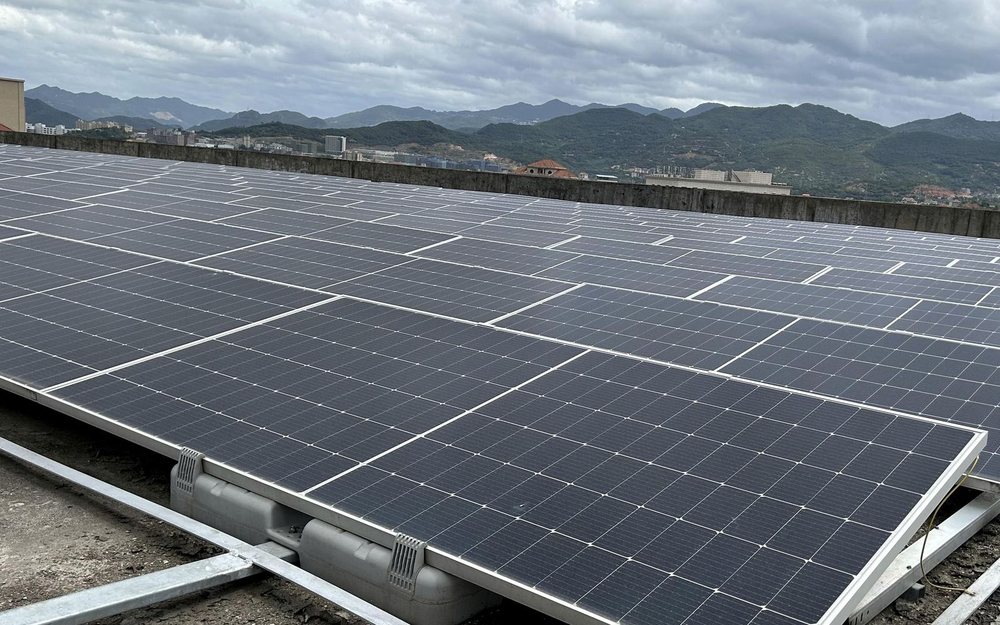
These are dates on which completed arrays carrying this bracket met real storm loading and were still standing afterwards. We supplied the mounting system; the installation was done by the customer and their own crew, on their own roof, under their own engineer's sign-off.
| Date | Event | Location | What it means |
|---|---|---|---|
| 2024-09-16 | Typhoon Bebinca, force 14 | Shanghai, Suzhou | Customer-installed ballasted arrays on industrial roofs came through the landfall wind field with no module loss and no displacement. |
| 2023-07-30 | Typhoon Doksuri, force 16 | Fujian | Super typhoon-strength wind over a coastal installation built by the customer's crew; array intact afterwards. |
Who did what, precisely. These roofs were installed by our customers, not by us. We supplied the bracket and the ballast layout; the roof survey, the installation labour and the structural sign-off were theirs. That is exactly why we cite them: the array held up in someone else's hands, on a roof we never touched. We do not present them as our own contracting work, and they are not a guarantee for your site — design pressure for your project comes from your local code and your own engineer.
Limits
0.55 kN/m² is the tested uplift resistance at the clamps. It is not the load-bearing capacity of your roof, and it must not be presented to a client as one. Ballast weight, point loads and membrane condition on an existing roof are signed off by the project structural engineer — we supply hardware, we do not take over that signature.
Write to us with the project, the country and who the report is for. The full documents are released by email to named buyers — they are not available as downloads on this site, and the issuing laboratory can be contacted directly to verify any of them.