Water-ballasted mounting Hebei, China · Export worldwide
Patented · CMA / CNAS tested
Mount solar without putting a single hole in the roof.
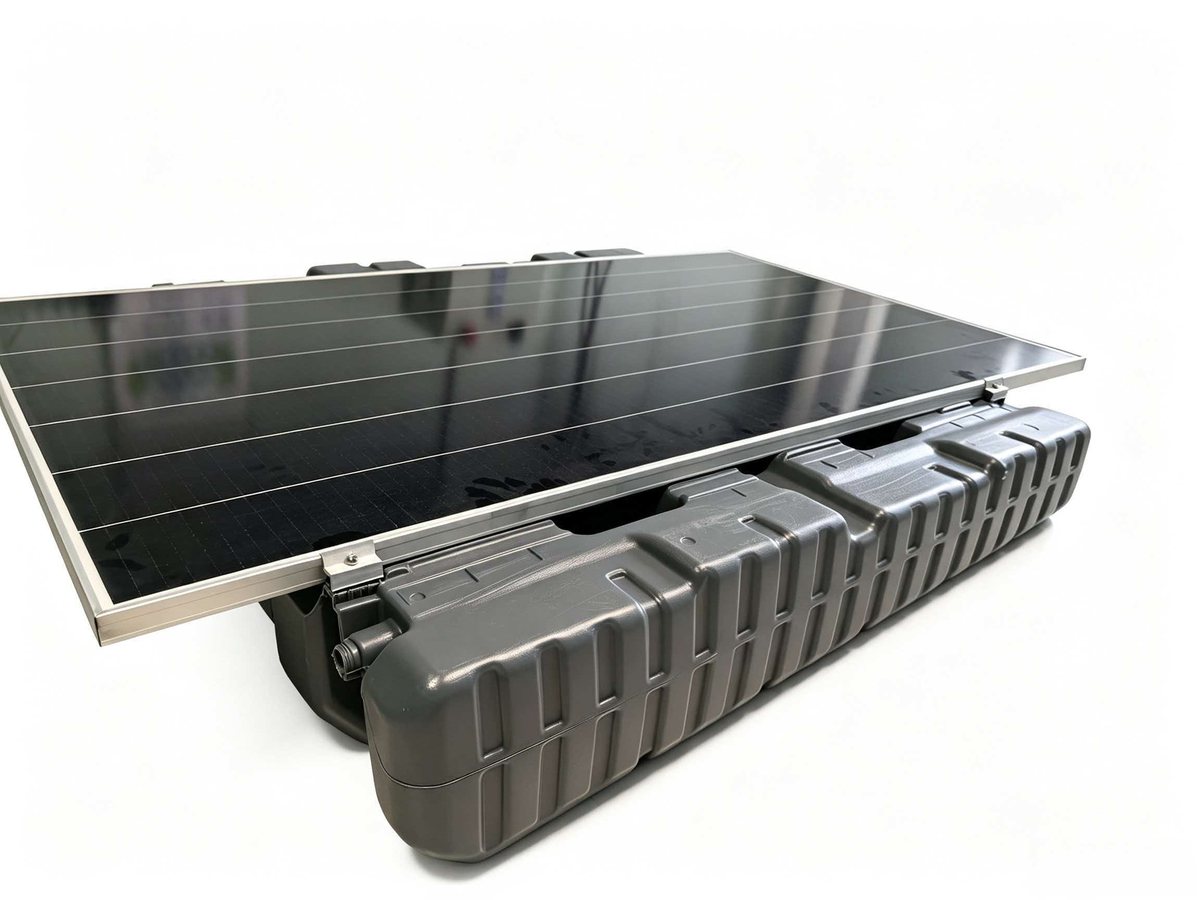
A hollow HDPE tank that becomes the ballast. Carry it up empty at 6.3 kg, fill it on site, and each unit turns into 120 kg of water weight holding the array down.
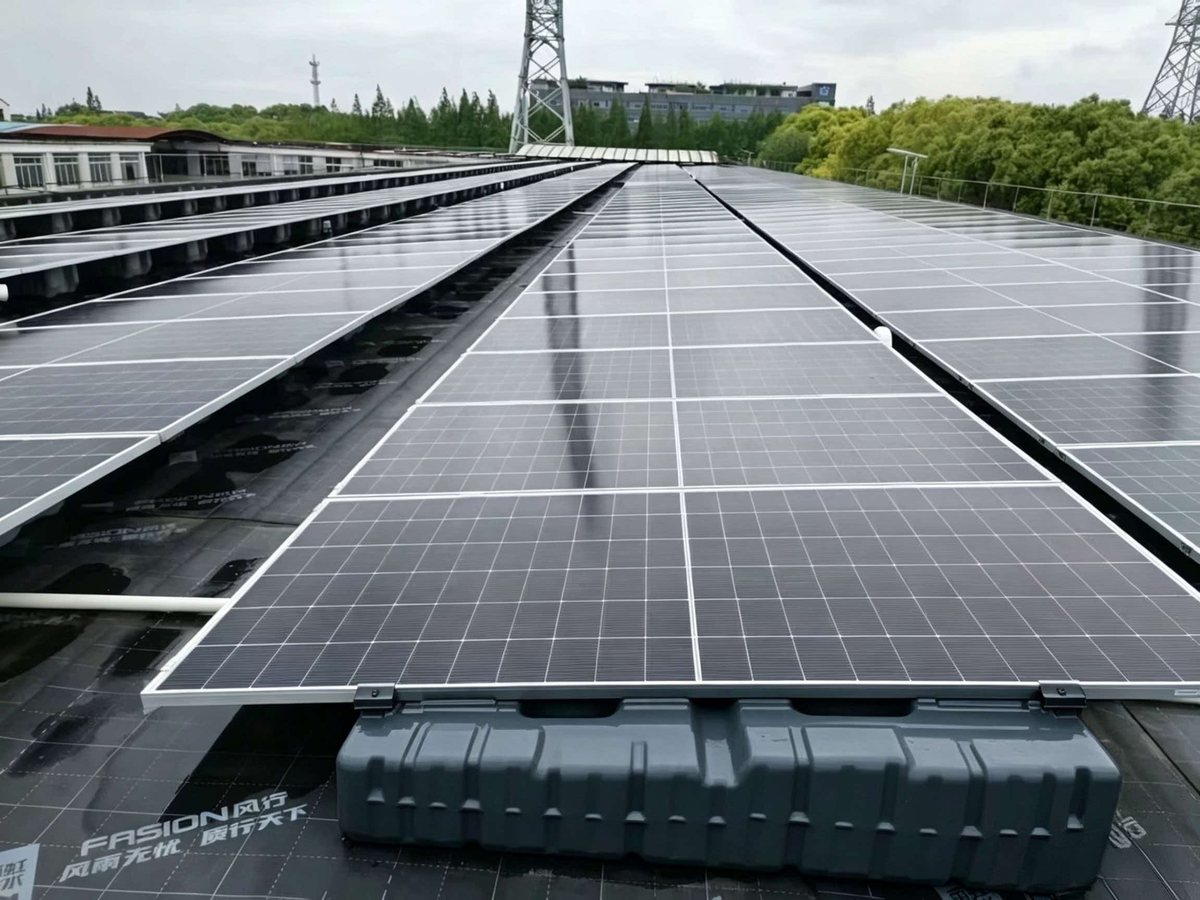
Completed array on an existing waterproofed roof — no penetrations, no ballast blocks, no crane.
A ballast that arrives empty and weighs 120 kg by lunchtime.
The system is a closed hollow HDPE tank that acts as both the support structure and the counterweight. Water is the only ballast medium — no sand, no gravel, no concrete blocks. Water is available on any site, costs nothing, and drains out when you need to move the array.
How it works
01
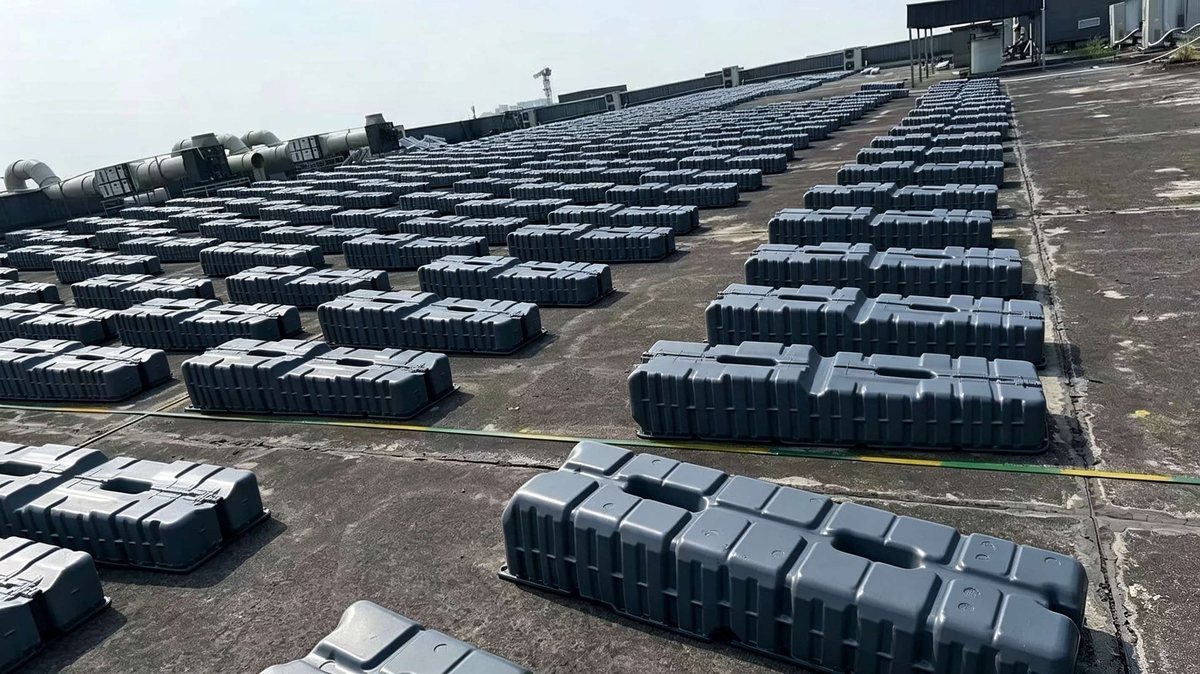
Position the tanks. Carry them up empty at 6.3 kg each — two people move a full row without equipment.
02
Lay the modules. The tank sits under the module joint, so two modules share one unit.
03
Clamp with one hand. Middle clamps on the shared edge, end clamps on the outer frame, one bolt each.
04
Fill with water. The array becomes self-weighted. Nothing is fixed to the roof structure.
Single unit carrying one module at approx. 5° tilt
Units per row = modules + 1
Adjacent modules share the tank at the seam. A row of 20 modules needs 21 units. This single rule is all your installer needs to order.
Against a conventional drilled system
Item
Drilled / concrete ballast
DINGXIU water ballast
Roof waterproofing
Penetrations cut the membrane, repair is required and warranty claims follow
Zero penetrations. Membrane untouched, existing warranty intact
Crew
Certified installers familiar with the rail system
General labour. No system-specific skill
Lifting equipment
Crane or hoist for concrete blocks and rails
Manual carry. 6.3 kg per unit, no machinery
Later modification
Dismantling damages rails and anchors, effectively scrap
Drain, lift, relocate. Fully reusable
Roof load
Concentrated point loads at anchors and block positions
Distributed over the tank footprint, low bearing pressure
Where it fits: concrete flat roofs · industrial and commercial rooftops · level ground · existing waterproofed membranes where drilling is prohibited · rooftops where a crane cannot reach.
DINGXIU SOLAR · Water-ballasted mounting system02
02System & specification
02 · System & specification
Four parts. Nothing to assemble on the roof.
System composition
Part
Function
Float body
Blow-moulded HDPE hollow tank. Becomes both support and counterweight once filled.
Middle clamp
Clamps the adjacent frames of two neighbouring modules on their shared edge.
End clamp
Clamps the outer frame of modules at the array edge.
Bolt
Fastens clamp to tank. Single-hand tightening, no torque tool required.
Ordering rules
Units per row
modules in that row + 1
End clamps
units × 2
Middle clamps
units × 2 − end clamps
Clamp size
by module frame thickness
Modules are mounted in portrait. The tank sits under the joint between two adjacent modules, tilted approx. 5°.
Main specification
Material
HDPE, blow-moulded one piece
Empty weight
approx. 6.3 kg
Filled weight
approx. 120 kg of water
Outside dimensions
1450 × 410 × 200 / 310 mm
Cavity volume
approx. 0.16 m³ per unit
Stacked pair volume
approx. 0.32 m³
Stacking density
approx. 6 sets per m³
Ballast medium
clean water only
Mounting tilt
approx. 5°
Module orientation
portrait
Fixing to roof
none — self-weighted
How many sets does 1 MW need
Module size
Modules per MW
Modules per row
Sets per row
Total sets, approx.
550 Wp
≈ 1 818
20
21
1 920
580 Wp
≈ 1 724
22
23
1 815
620 Wp
≈ 1 613
20
21
1 710
Assumes an ideal rectangle. Real roofs lose rows to setbacks, skylights and walkways, so add 3–5%. We issue an exact layout and quantity count from your roof drawing before you order — free of charge.
Units positioned, rows ready for modulesModule clamped, 6.3 kg per empty unitFilled and commissioned, no roof fixings
DINGXIU SOLAR · Water-ballasted mounting system03
03Testing & certification
03 · Testing & certification
Every claim below has a report number behind it.
The product is tested by Tianjin Bailun Inspection & Testing, a third-party laboratory holding both CMA and CNAS accreditation, and by the Hebei Gengqiang New Energy laboratory for pull-out strength. Report numbers can be verified with the issuing body.
1000 hoursUV ageing · pass
GB/T 16422.3-2022, UVA-340 lamp, 8 h light at 60 °C + 4 h condensation at 50 °C, 84 cycles. No cracking, no chalking, no significant colour change.
−40 °C × 168 hCold · pass
Stored at −40 °C for 168 hours. No damage, no cracks, no surface defects. Suitable for cold-climate winter operation.
105 °C × 200 hDry heat · pass
Stored at 105 °C for 200 hours. No significant surface defects. Withstands summer rooftop heat.
200 cyclesThermal cycling · pass
IEC 61215-2:2016 MQT 11 reference, −40 °C to +85 °C, 200 cycles. No significant surface defects.
0.55 kN/m²
Pull-out test including elevated temperature. No tearing and no failure at the clamp. Result: PASS. Report JTTR-PZ-A-04-003.
Equivalent wind speed
≈ 30 m/s
108 km/h · Beaufort 11
What 0.55 kN/m² means in wind speed
Wind speed
Dynamic pressure
Beaufort
Against the tested 0.55 kN/m²
20 m/s (72 km/h)
0.245 kN/m²
8
Within tested range
25 m/s (90 km/h)
0.383 kN/m²
10
Within tested range
30 m/s (108 km/h)
0.551 kN/m²
11
At the tested limit
35 m/s (126 km/h)
0.750 kN/m²
12
Above tested range — ask us
40 m/s (144 km/h)
0.980 kN/m²
12+
Above tested range — ask us
Conversion uses q = 0.5 ρ v² at standard air density ρ = 1.225 kg/m³ (15 °C, sea level). Compare this table with the design wind speed your local code requires for the building. Inside the tested range the system fits mechanically; above it, we quote additional units or a different configuration. Final ballast sizing is issued per project.
Eight reasons the second project is easier than the first.
01
No roof damage
Water ballast replaces ground screws and expansion bolts. The waterproofing membrane is never opened, so the roof warranty you are responsible for stays intact.
02
Half the schedule
About 12 days per MW against roughly 30 for a drilled system. Grid connection arrives earlier, and earlier connection is the only advantage that shows up directly in the IRR.
03
Four-step install
Position, lay, clamp, fill. No rail cutting, no alignment jigs, no torque specification. General labour can do it after ten minutes of instruction.
04
Light to carry
6.3 kg empty. Two people move a whole row by hand — no crane, no hoist, no scaffold, which matters on a finished industrial roof.
05
Any module
Fits any framed module. Only the clamp profile changes with frame thickness, so you are not locked to one module brand.
06
Reusable
Drain and lift. Useful for roof maintenance access, array reconfiguration, or relocating the plant — the asset moves with you instead of being scrapped.
07
Weather proven
HDPE body with a UV stabiliser system, validated by 1000 h UV ageing, −40 °C cold, 105 °C dry heat and 200 thermal cycles.
08
Dense to ship
Tanks nest in pairs at about 6 sets per m³. 197 sets fit a 20GP, 350–400 fit a 40HC. Per-set freight drops accordingly.
Where the saving comes from — 1 MW rooftop, itemised
Cost line
Drilled system
Water ballast
Saving per MW
Mounting material
≈ ¥0.20 /W
≈ ¥0.20 /W
roughly equal
Concrete ballast blocks + crane
¥30 000–45 000
none
¥30 000–45 000
Membrane repair after drilling
¥10 000–15 000
none
¥10 000–15 000
Install labour (18 days shorter)
specialist crew
general labour
¥15 000–25 000
Typical total
—
—
¥55 000–85 000
Ranges reflect north China labour and material rates in 2026 for a 1 MW distributed rooftop. Replace the unit rates with your own local figures — the structure of the saving does not change: you are buying labour, lifting and waterproofing repair, not steel. In markets where skilled installers are scarce or wages are high, the gap widens.
Lead time. 200 sets ex-works in 10–15 days; full container loads 20–25 days. Tell us the target vessel and we plan production backwards from it.
What we send free. Layout drawing, quantity count from your roof plan, wind calculation basis, datasheet, and the full test reports on request.
DINGXIU SOLAR · Water-ballasted mounting system05
05Logistics & contact
05 · Logistics
It ships as air, not as steel.
An empty tank is mostly void, so the whole product is volumetric cargo. Tanks nest in pairs, which is why the per-set freight cost is low even on long routes.
Vehicle
Capacity
13 m flatbed truck
450 sets (weighed at loading)
9 m truck
≈ 235 sets
6.5 m truck
≈ 140 sets
20GP container
197 sets (weighed at loading)
40GP container
≈ 350–360 sets
40HC container
≈ 400 sets
Stacked pair ≈ 0.32 m³, single set ≈ 0.16 m³, about 6 sets per m³. A 40HC at 400 sets weighs roughly 2.5 t gross of product — the container cubes out long before it weighs out.
Delivery sequence
01
Order
Quantity confirmed, production slot booked
02
Produce
Batch moulded, inspected per unit
03
Ship
Container loaded, documents issued
04
Support
Remote install guidance on arrival
Send us your roof plan
Roof area, module wattage and rows per array is enough. We return a layout drawing, the exact set count and a quotation — normally within one working day.
Contact
Talk to the factory, not to a marketplace listing.
WhatsApp+86 136 3089 0797Message us — replies within one working day
WeChat+86 136 3089 0797
Emailnereosong@dingxiusolar.com
Webwww.dingxiusolar.com
CompanyHEBEI DINGXIU INTERNATIONAL TRADE CO., LTD.East side of Kaiyuan Road, 200 m south of Shuangta, Baita Town, Shahe City, Xingtai, Hebei, China
Scan to open WhatsApp with the message already written
Patent 202630294473.0 · Tested by Tianjin Bailun (CMA / CNAS) report BL9B936C52 · Pull-out JTTR-PZ-A-04-003 · Specifications subject to the product actually supplied · Reports available on request